Short answer
How hot is too hot to walk a bulldog? Do not walk a bulldog when the air temperature is above 80°F (27°C). Between 70°F and 80°F (21–27°C), keep walks short, stay in the shade, and watch for panting. Below 70°F (21°C) is safe for most bulldogs. Bulldogs overheat faster than other dogs because their flat faces make panting — a dog’s main way of cooling down — less effective.
How hot is too hot to walk a bulldog?
The full picture is a sliding scale, not a single number. The table below is the same guidance our Dog Walking Temperature Chart is built on — air temperature, risk level, and what to do. A temperature that is merely “warm” for a Labrador can be dangerous for a bulldog.
| Air temperature | Risk level | What to do |
|---|---|---|
| Below 32°F (0°C) | Dangerous — freezing | Highly risky for small, short-haired, or senior dogs. Keep walks very short and consider protective booties. |
| 32°F to 45°F (0–7°C) | Caution — cold | Shorten walks for puppies, seniors, and short-haired dogs once it drops below 40°F (4°C). |
| 45°F to 70°F (7–21°C) | Safe | Universally safe for all breeds and sizes. Ideal for long walks. |
| 70°F to 80°F (21–27°C) | Caution — warm | Safety depends on breed, weight, and coat. Watch for heavy panting and choose shaded paths. Flat-faced breeds need extra care. |
| Above 80°F (27°C) | Dangerous — heat stroke risk | Walk only in the early morning or late evening, or keep your dog indoors. Flat-faced (bulldog) breeds overheat fastest — keep indoors with air conditioning. |
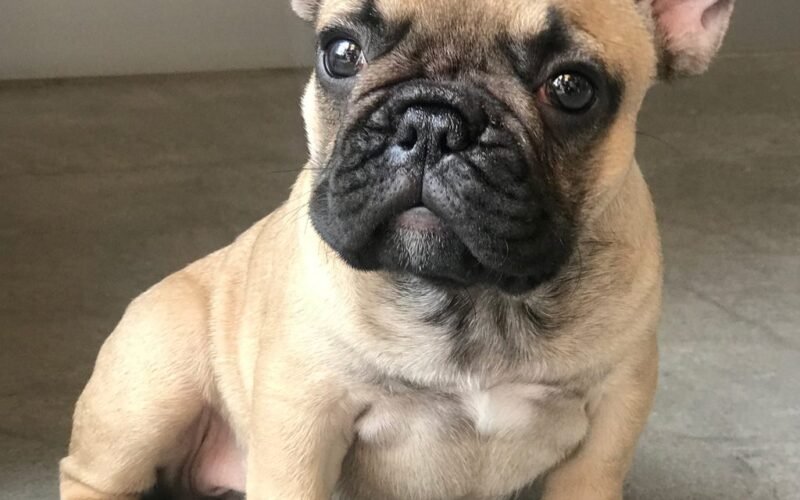
For a bulldog, read that table one step more strictly than it is written. The “Safe” band up to 70°F (21°C) is genuinely safe for most bulldogs, and it is where the best walks happen. In the “Caution — warm” band from 70°F to 80°F (21–27°C), make a judgement call: a fit young French Bulldog on a shaded morning walk at 72°F is a different proposition from an overweight senior English Bulldog on sunny asphalt at 78°F. Keep the walk short, stick to shade and grass, carry water, and cut it short the moment the panting gets heavy. Above 80°F (27°C), the judgement call is over: do not walk a bulldog. Wait for the evening cool-down, or play indoors instead.
Two things make the thermometer reading incomplete. The first is humidity: panting cools by evaporation, which is exactly what humid air prevents, so a humid 76°F can be harder on a bulldog than a dry 80°F. That is why our Dog Walking Temperature Chart asks for humidity as well as temperature. The second is the sun: a shaded thermometer does not measure what your bulldog feels standing on sun-baked asphalt, and the ground under its paws can be far hotter than the air — more on that below.
Why do bulldogs overheat so easily?
Bulldogs are brachycephalic — flat-faced — with shortened skulls and narrowed airways: smaller nostrils, a long soft palate, and a narrow windpipe. The condition is called brachycephalic obstructive airway syndrome (BOAS), and it is the biggest reason a bulldog overheats faster than a longer-nosed dog. Panting is how a dog sheds heat, and a bulldog’s breathing apparatus is less good at it: every breath moves less air, and the effort of breathing itself generates heat.
That is not a minor difference. A dog cools itself almost entirely by panting, which evaporates moisture from the tongue and upper airways — dogs barely sweat at all, only a little through their paw pads. So a bulldog pants with a cooling system already at a disadvantage, and when the air is hot and humid, evaporation slows and the system struggles further. A bulldog’s temperature can climb quickly once the air passes the low 70s, and once it climbs, it is hard to bring back down without help.
Several things make an individual bulldog more vulnerable still. Being overweight is one of the biggest: extra fat insulates the body and makes every step harder work. Age matters at both ends — puppies and senior dogs cope worse with heat than healthy adults — and so does existing breathing trouble: a bulldog that already snores loudly or struggles to breathe at rest is starting from a worse position on a hot day.
None of this means bulldogs cannot enjoy warm weather — it means their margin for error is smaller. A lean, fit bulldog walked in the cool of the morning can enjoy a summer day perfectly well; an overweight bulldog walked at midday on asphalt, with no water and no shade, is in danger at temperatures that would barely bother another breed.
If your bulldog’s breathing worries you in general — loud snoring, noisy breathing at rest, or struggling after light exercise — read our guide to bulldog breathing issues, and talk to your vet. Breathing problems and heat risk are the same problem wearing two hats.
Can bulldogs handle heat?
Poorly — and honestly is the only useful answer. Bulldogs can live happily in warm climates, but they handle heat by avoiding it rather than tolerating it: a good hot day for a bulldog is a cool room, a fan, and a short trip outside. That is the trade-off of the flat face, and managing it is part of owning one.
Handling heat, for a bulldog, means a routine built around the cool parts of the day: walks early in the morning and late in the evening, midday rest indoors with air conditioning or a fan and a cool floor to lie on, and cool fresh water always available. Exercise is gentle and short — a stroll, not a run — and it stops at the first sign of heavy panting.
Bulldogs do not acclimatise to heat the way people do: a month in hot weather does not make a bulldog meaningfully better at cooling itself, because the limitation is anatomical. And do not assume that because your dog coped last summer, it will cope this summer — age, weight, and health all shift from year to year.
Heat danger is not only about walks: a bulldog left in a garden with no shade, or shut in a stuffy room, can overheat without taking a single step. And never leave a bulldog in a parked car: even on a mild 70°F (21°C) day, the inside can pass 100°F (38°C) in well under half an hour, and a bulldog inside it has no way out and no way to cool down. The same applies to conservatories and any small sun-trap room.
Is the pavement too hot for your bulldog’s paws?
The air temperature is only half the question: the ground your bulldog walks on can be far hotter than the air, and it is the ground that burns paws. Dark asphalt in direct sun absorbs almost all the sunlight that hits it, and on a sunny day it runs far hotter than the air — hot enough to burn paw pads in about a minute.
The figures below are approximate, for dark asphalt in full sun. The exact temperature depends on the colour and age of the surface, how long the sun has been on it, and whether there is any wind — but the pattern is consistent, and it surprises most owners.
| Air temperature | Asphalt in full sun (approx.) | Risk to paws |
|---|---|---|
| 77°F (25°C) | About 125°F (52°C) | Burns possible in about 60 seconds |
| 86°F (30°C) | About 135°F (57°C) | Burns in under a minute |
| 95°F (35°C) | About 149°F (65°C) | Burns very quickly |
Note the first row: on a pleasant 77°F day — weather most people would call perfect for walking — sun-baked asphalt can already burn your bulldog’s paws in about a minute. Pale concrete runs cooler than dark asphalt, and grass stays much cooler than either, so the surface matters as much as the temperature.
You do not need a thermometer to check. Use the seven-second test, which veterinary organisations including the American Veterinary Medical Association (AVMA) recommend: press the back of your bare hand flat on the pavement and hold it there for seven seconds. If you cannot hold it there comfortably for the full seven seconds, the surface is too hot for your bulldog’s paws. Walk on shaded grass instead, wait for the evening, or use protective booties — and if your bulldog does walk on hot ground, check its paws afterwards for redness, blisters, or a reluctance to put weight on them.
What are the signs your bulldog is overheating?
Overheating usually announces itself early, and the early signs are the ones that matter — your chance to act before it becomes an emergency. Learn them, and check for them on every warm-weather walk.
Early signs to watch for:
- Heavy panting that does not settle. All dogs pant when they are warm, but a bulldog that is panting hard, with its tongue fully out and its breathing fast and shallow, and that does not ease off after a minute or two in the shade, is struggling to cool down.
- Thick, ropey drool. Saliva that is thicker than usual, or drool hanging in strings, is a classic early sign of heat stress.
- Bright red gums or tongue. Gums that look much redder than usual mean the body is pushing blood to the surface to shed heat.
- Restlessness or seeking shade. A bulldog that keeps trying to lie down, that hunts for shade or water, or that suddenly refuses to walk further is telling you it is too hot.
- A dazed or wobbly look. Disorientation, stumbling, or a glazed expression means the heat is already affecting the brain, and this is urgent.
If overheating progresses to heatstroke, the signs get worse quickly: vomiting or diarrhoea (sometimes with blood), stumbling or collapse, muscle tremors, seizures, or unresponsiveness, and gums may go from bright red to pale or grey-blue. Heatstroke is a veterinary emergency that can cause organ failure and death within hours, and it can also cause damage that only shows up days later — so a dog that had a bad episode needs a vet check even if it looks better afterwards.
A dog’s normal body temperature is about 101–102.5°F (38.3–39.2°C). Vets generally treat a body temperature above 104°F (40°C) as heatstroke, and above 106°F (41°C) as severe and life-threatening. You cannot judge this by touch — only a rectal thermometer gives a reliable reading — so if your bulldog is showing the signs above, start cooling it and get it to a vet; do not wait to take its temperature.
What to do if your bulldog overheats
If your bulldog is showing signs of overheating, act now — heatstroke gets worse fast, and the first few minutes of cooling make a real difference:
- Move your bulldog into the shade or an air-conditioned room immediately. Get it out of the sun and off hot ground, and stop all exercise.
- Offer small amounts of cool water to drink. Let it drink a little at a time. Do not force water into its mouth, and do not let it gulp large amounts at once.
- Cool your dog with cool water, not ice. Pour cool water over its body — especially the belly, paws, and head — or drape wet towels over it. Do not use ice or ice-cold water, which can constrict the blood vessels and make cooling less effective.
- Get air moving over your dog. Put a fan on it, or move it into a breeze. Evaporation from the wet coat is what carries the heat away.
- Take your dog’s temperature if you can do so safely with a rectal thermometer. Stop active cooling once the temperature reaches about 103°F (39.4°C) — cooling below that risks chilling the dog.
- Call your vet or an emergency vet clinic now. Do this even if your dog looks better. Heatstroke can damage the kidneys, liver, and brain in ways that do not show up for hours or days, so a vet check after any serious overheating is not optional.
Do not wait to see if it passes, and do not try to “walk it off.” Note what happened — the temperature, the time of day, how long the walk was — and adjust the routine so it does not happen again.
How to walk your bulldog safely in hot weather
Most heat problems are preventable. These habits keep a bulldog safe through the summer:
- Walk early and late. The coolest parts of the day are early morning and late evening. On a hot day, those are the only walks that happen; the midday walk is replaced by a short garden trip in the shade.
- Choose grass and shade. Route walks over grass and shaded paths rather than dark asphalt, and do the seven-second pavement test before you set off. If the ground is too hot for your hand, it is too hot for paws.
- Carry water. Bring cool water and a collapsible bowl on every warm-weather walk, and offer it regularly rather than waiting for your dog to look thirsty.
- Keep it short and slow. A gentle stroll is enough on a hot day. Skip the ball games, the running, and the long hikes until the weather cools. Let your bulldog set the pace, and head home at the first heavy panting.
- Watch the humidity, not just the temperature. Humid air makes panting less effective, so a muggy day is more dangerous than a dry day at the same temperature. If the air feels close and heavy, be more cautious.
- Know your dog. A young, lean, fit bulldog copes better than an older, overweight, or unfit one. If your dog is carrying extra weight, that is one more reason to keep walks short and cool — and our weight guide explains how to check whether your bulldog is overweight.
- Never leave a bulldog in a parked car. Not for a minute, not with the windows cracked, not on a mild day. A parked car heats up far faster than most people expect, and a bulldog has no way to cool down inside one.
For more summer cooling ideas — from cooling mats and paddling pools to what to do about a bulldog that loves sunbathing — see our 7 vital English Bulldog cooling tips to prevent summer overheating safely.
Check the temperature before every walk
How hot is too hot to walk a bulldog? The simplest habit in this article is also the most useful: check before you go. Our free Dog Walking Temperature Chart takes the air temperature and the humidity and tells you whether it is safe to walk your dog, with the flat-faced risk spelled out — the same guidance as the table at the top of this article, in a form you can use in ten seconds before you pick up the lead. If it says caution or danger for a bulldog, believe it: it is better to skip a walk than to cut one short halfway round the block with an overheating dog. Make it part of the routine, like checking for rain.
Frequently asked questions
How hot is too hot to walk a bulldog?
Do not walk a bulldog when the air temperature is above 80°F (27°C). Between 70°F and 80°F (21–27°C), keep walks short, stay in the shade, and watch for heavy panting. Below 70°F (21°C) is generally safe for most bulldogs, and that is the best time for longer walks.
Is 75°F too hot to walk a bulldog?
It is borderline, and it depends on the dog and the conditions. At 75°F (24°C), a fit young bulldog can usually manage a short, shaded walk in the morning or evening, but an older, overweight, or unfit bulldog may struggle — especially if it is humid or the sun is strong. Keep it short, stick to grass and shade, carry water, and cut it short at the first sign of heavy panting.
Can bulldogs handle heat?
Poorly. Bulldogs are brachycephalic — flat-faced — so their narrowed airways make panting less effective, and panting is how dogs cool down. They can enjoy warm weather with shade, water, and short outings in the cool of the day, but they cannot tolerate heat the way longer-nosed breeds can, and they do not acclimatise to it.
How do I check if the pavement is too hot for my bulldog?
Press the back of your bare hand flat on the pavement and hold it there for seven seconds. If you cannot hold it there comfortably for the full seven seconds, the surface is too hot for your bulldog’s paws. On a sunny 77°F (25°C) day, dark asphalt can already reach about 125°F (52°C) — hot enough to burn paws in about a minute — so walk on shaded grass instead.
What should I do first if my bulldog overheats?
Move your bulldog into the shade or an air-conditioned room straight away, offer small amounts of cool water, and cool it with cool water (not ice) and a fan. Then call your vet immediately, even if your dog looks better — heatstroke can cause damage that only shows up hours or days later, so a vet check after any serious overheating is essential.
Sources and notes: Temperature thresholds and the pavement test follow this site’s own Dog Walking Temperature Chart. Body temperature figures and heatstroke signs follow veterinary emergency guidance (Merck Veterinary Manual; VCA Animal Hospitals). Pavement temperatures are approximate figures for dark asphalt in full sun, as commonly cited in veterinary heat-safety guidance. The seven-second pavement test is recommended by the American Veterinary Medical Association (AVMA). This article is educational and is not a substitute for veterinary advice — if your bulldog is overheating, contact your vet immediately. The Fluffy Bulldog is run by Liam K. — read more on the About page.
Not sure where to start?
Try one of our free bulldog tools — weight, feeding, walking-temperature and more.
Browse all free tools