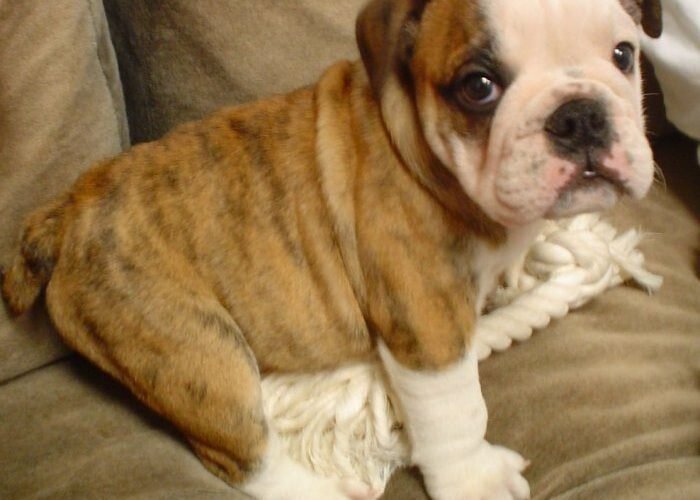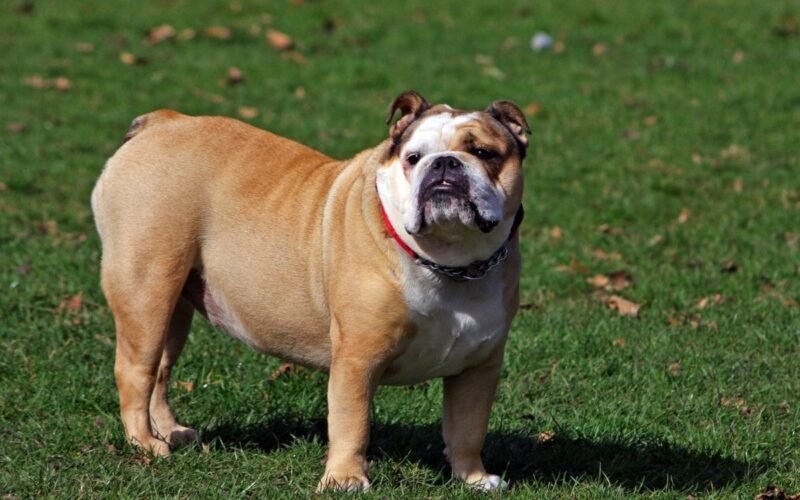
Short answer
How much should a bulldog eat per day? An adult English Bulldog needs about 980–1,250 calories a day, roughly 2¾–3⅝ cups of a typical kibble. A French Bulldog needs about 480–770 calories (1⅜–2¼ cups), and an American Bulldog about 1,330–2,230 calories (3¾–6⅓ cups). The exact amount depends on your dog’s weight, age and activity.
How much should a bulldog eat per day? It depends on the breed
“Bulldog” covers three very different dogs, and their daily food amounts barely overlap. A French Bulldog eats roughly half what an English Bulldog eats, and an American Bulldog can eat nearly twice as much. So the first step in answering how much a bulldog should eat per day is knowing which bulldog you have — and how much it weighs.
The table below gives the daily calories and kibble for a typical neutered adult of each breed and sex. The adult weights are the ranges in our weight guide, which follows the American Kennel Club (AKC) breed standards, and the calories come from this site’s own feeding formula, which powers our Dog Feeding Calculator. Cups assume a typical kibble at about 350 calories per cup.
| Breed | Adult weight | Daily calories | Kibble per day |
|---|---|---|---|
| English Bulldog, male | 23–25 kg (50–55 lb) | 1,176–1,252 kcal | 3.36–3.58 cups |
| English Bulldog, female | 18–23 kg (40–50 lb) | 979–1,176 kcal | 2.80–3.36 cups |
| French Bulldog, male | 9–13 kg (20–28 lb) | 582–767 kcal | 1.66–2.19 cups |
| French Bulldog, female | 7–12 kg (16–26 lb) | 482–722 kcal | 1.38–2.06 cups |
| American Bulldog, male | 32–54 kg (70–120 lb) | 1,507–2,231 kcal | 4.31–6.37 cups |
| American Bulldog, female | 27–45 kg (60–100 lb) | 1,327–1,946 kcal | 3.79–5.56 cups |
A daily amount is a range, not a single number. Two adult male English Bulldogs can both be perfectly healthy on different amounts — build, muscle and activity all shift the right number for an individual dog. If your dog is gaining or losing weight on the amount in the table, the amount is wrong for your dog, whatever the table says — adjust it gradually and check with your vet if the trend continues. These figures are estimates for healthy adult dogs, not prescriptions: puppies, pregnant or nursing dogs, and dogs with medical conditions need different amounts, set by your vet.
How the number is worked out: RER and MER
Every calorie figure in this guide comes from one formula — the same formula vets use, and the one built into our Dog Feeding Calculator. It has two steps.
Resting energy requirement (RER) is the calories a dog burns at rest, just keeping its body running — breathing, digesting, keeping warm. Maintenance energy requirement (MER) is the RER multiplied by a factor for the dog’s life stage and activity — the calories it actually needs each day.
The formula for resting energy requirement is:
RER = 70 × (body weight in kg)^0.75
Then the RER is multiplied by a factor matching the dog’s life stage and activity:
| Life stage / activity | Multiplier |
|---|---|
| Neutered adult (typical activity) | 1.6 × RER |
| Intact adult | 1.8 × RER |
| Weight loss target | 1.0 × RER |
| Active / working dogs | 2.0–5.0 × RER |
| Puppy under 4 months | up to 3.0 × RER |
| Older puppy | about 2.0 × RER |
A neutered adult needs less than an intact adult of the same weight, because neutering lowers the metabolic rate. A puppy needs far more for its size than an adult, because it is building bone and muscle as well as maintaining itself. Once you have the daily calories, divide by the calories per cup on your kibble bag to get the cups — the tables in this guide use 350 calories per cup, a typical figure for dry food.
Worked example: a 12 kg neutered dog
Here is the calculation done step by step, so you can check it against the calculator — and against any other guide that gives you a number without showing its working.
A 12 kg neutered adult dog, at typical activity, uses the 1.6 multiplier:
- RER = 70 × 12^0.75 = 451.3 calories. This is what the dog burns at rest.
- MER = 451.3 × 1.6 = 722.1 calories per day. This is what the dog actually needs.
- Cups = 722.1 ÷ 350 = 2.06 cups of a typical kibble per day.
And for a 23 kg adult male English Bulldog, the same steps give RER 735.2, MER 1,176.3 calories per day, and 3.36 cups. Those are the numbers in the breed table above — the table is this calculation done for every weight. If another guide gives you a different number for the same dog, ask what formula it used: a feeding amount with no formula behind it is a guess, and one with the formula shown can be checked.
Bulldog feeding chart by age
Puppies eat more for their size than adults, and they eat more often. The table below is for an English Bulldog puppy at the weights on our growth curves — the same curves behind our weight guide — with the puppy multipliers from our feeding calculator: up to 3.0 × RER under four months, about 2.0 × RER for older puppies.
| Age | Weight (male) | Multiplier | Daily calories | Kibble per day | Meals per day |
|---|---|---|---|---|---|
| 8 weeks (2 months) | 4 kg (9 lb) | up to 3.0 × RER | 594.0 kcal | 1.70 cups | 4 |
| 3 months | 7 kg (15 lb) | up to 3.0 × RER | 903.7 kcal | 2.58 cups | 4 |
| 4 months | 10 kg (22 lb) | about 2.0 × RER | 787.3 kcal | 2.25 cups | 3 |
| 6 months | 15 kg (33 lb) | about 2.0 × RER | 1,067.1 kcal | 3.05 cups | 3, moving to 2 |
| 12 months | 23 kg (51 lb) | about 2.0 × RER | 1,470.4 kcal | 4.20 cups | 2 |
Two things in this table are worth noticing. First, the daily total dips between 3 and 4 months even though the puppy is growing — the multiplier drops from up to 3.0 to about 2.0 at four months, and the multiplier matters more than the extra 3 kg. It is normal, and the calculator follows the same multipliers. Second, the 12-month figure is high because the dog is still growing: at a year old an English Bulldog is near its adult weight but still broadening and adding muscle, so it still eats at the puppy rate. The multiplier falls to the adult 1.6 × RER as growth finishes, between 12 and 24 months.
Puppies are usually fully weaned by 7–8 weeks, which is why the table starts at 8 weeks — a younger puppy should still be with its mother or on a weaning plan agreed with your vet or breeder. As your puppy grows, re-check the amount every few weeks: its weight changes fast, and a portion that was right at 3 months is wrong at 6 months. The calculator takes the puppy’s current weight, so it stays right as the puppy grows. For more on the first weeks at home, see our French Bulldog puppy care notes.
How much should a bulldog eat per day in cups?
Cups are the unit most owners actually measure in, so here is the table from our feeding calculator: daily calories and kibble for a neutered adult dog at typical activity, at 350 calories per cup.
| Dog weight | Daily calories (MER) | Kibble per day |
|---|---|---|
| 5 kg | 374.5 kcal | 1.07 cups |
| 10 kg | 629.8 kcal | 1.80 cups |
| 15 kg | 853.7 kcal | 2.44 cups |
| 20 kg | 1,059.2 kcal | 3.03 cups |
| 25 kg | 1,252.2 kcal | 3.58 cups |
| 30 kg | 1,435.7 kcal | 4.10 cups |
Find your dog’s weight, read across, and you have the daily amount. A 23 kg dog sits between the 20 kg and 25 kg rows — about 1,176 calories and 3.36 cups, as the breed table shows. If your dog’s weight falls between two rows, the calculator gives the exact figure for that weight.
But cups depend on your food. The only number that matters is the calories, and the only way to get the cups right is to divide by your own food’s calories per cup, printed on the bag. A 23 kg dog needing 1,176 calories a day eats 3.36 cups of a 350-calorie food — but the same dog eats 2.94 cups of a 400-calorie food, and 3.92 cups of a 300-calorie food. Two bags that look the same can be 100 calories a cup apart, which is the difference between holding weight and gaining it.
Measure the food. Use a proper measuring cup or kitchen scales, not a mug or a scoop — a “scoop” is not a measure. Wet food does not convert by cups: a tin of wet food is mostly water, so it carries far fewer calories per gram than kibble. If you feed wet food, follow the feeding guide on the tin for your dog’s weight.
How often should you feed a bulldog?
An adult bulldog should eat twice a day, morning and evening, roughly 12 hours apart. Puppies eat three or four times a day, as the age table above shows, dropping to two meals as they approach a year old.
Two meals suit a bulldog better than one. Bulldogs gulp their food, and one large meal is harder on digestion than two smaller ones; vets generally advise against feeding one large meal a day to deep-chested breeds. Two meals also keep the dog from going hungry between feeds, which matters for a breed that is famously persuasive about snacks.
Feed at the same times each day, and do not leave food down all day. Free-feeding — a full bowl left out around the clock — makes it impossible to know how much your dog has eaten, and most bulldogs will eat past the point they need. Serve a measured amount at set times, and take it up after 15–20 minutes if uneaten.
What to feed a bulldog
Choose a food that is complete and balanced for your dog’s life stage — puppy, adult or senior — and check the label for a statement of nutritional adequacy (AAFCO in the United States, FEDIAF in Europe).
Do not choose by breed marketing. A food labelled “for bulldogs” is not automatically better than a good-quality food for medium breeds at the right life stage. What matters is the life stage, the calorie content per cup — because that decides the portion — and whether your dog does well on it: firm stools, a healthy coat, steady weight and good energy. Bulldogs are known for sensitive stomachs, so introduce any new food gradually over about a week, mixing a little more of the new food in each day.
Wet food and dry food can both work. Dry food is easier to measure and store, and the cups in this guide assume kibble. Wet food has more water per calorie, so portions look bigger for the same energy. Some owners mix the two, which is fine as long as the total calories are counted. Raw diets need more care: they must be carefully formulated to be complete and balanced, and portions have to be worked out by weight rather than cups — if you feed raw, work out the portion with your vet.
How to tell if you’re feeding the right amount
The scale and the table give you a starting amount, but your dog’s body tells you whether it is right. Vets use a body condition score — the 9-point scale published by the World Small Animal Veterinary Association (WSAVA) — and you can do a simplified version at home in about a minute. Our weight guide explains the three checks in full: feel the ribs, look for a waist from above, and check the tuck from the side. In short, you should be able to feel the ribs easily under a thin layer of fat, see a waist behind the ribs from above, and see the belly tuck upward from the side. A score of 4 or 5 is ideal.
If you cannot feel the ribs without pressing, or there is no waist, your dog is getting too much — even if the amount matches the table. If the ribs are sharp and visible with no fat cover, your dog is getting too little. Weigh your dog monthly on the same scale, and if the trend is up or down over a few weeks, adjust the food by 10–20% and wait three to four weeks before changing it again. If the weight keeps moving despite the adjustment, or your dog is losing weight without explanation, see your vet — weight loss in an adult dog can be a sign of a medical problem that no amount of extra food will fix.
Treats, chews and table scraps
Treats count. The usual guidance is to keep treats under 10% of daily calories — for a 23 kg English Bulldog on 1,176 calories a day, that is under about 118 calories of treats. Training treats, dental chews, a biscuit for being good and a scrap from the table all come out of the same allowance, and they add up fast on a dog that only needs around a thousand calories.
Use small treats, and break larger ones in half. If you are doing a lot of training on a given day, take the treat calories out of the meals rather than adding them on top. Table scraps need care: fatty scraps can upset a bulldog’s stomach, cooked bones can splinter, and some ordinary human foods are toxic to dogs — chocolate, grapes and raisins, onions and garlic, and anything sweetened with xylitol. If your dog eats any of these, contact your vet straight away.
What about senior bulldogs?
Older bulldogs are usually less active, so many seniors need fewer calories than the 1.6 × RER adult figure — but there is no single senior multiplier, and guessing one would be inventing a number. Use the calculator with your dog’s current weight, watch the body condition checks above, and ask your vet about a senior food and portion for your dog. Weight alone tells you less in an older dog than it used to: seniors can lose muscle while gaining fat, so the scale can stay the same while the body changes, and the rib, waist and tuck checks matter more than ever.
Check your bulldog’s food amount with our calculator
How much should a bulldog eat per day? The fastest way to put all of this together is to work out the number for your own dog. Our free Dog Feeding Calculator takes your bulldog’s weight, life stage and activity, and gives you the daily calories and the kibble portion from the same formula used in this guide — RER = 70 × kg^0.75, with the multipliers above. Enter your dog’s weight, choose its profile, and you will see its daily target in calories and cups. If the result surprises you, check the portion against the tables in this guide, run the body condition checks, and talk to your vet.
Frequently asked questions
How much should a bulldog eat per day?
An adult English Bulldog needs about 980–1,250 calories a day (2¾–3⅝ cups of typical kibble), a French Bulldog about 480–770 calories (1⅜–2¼ cups), and an American Bulldog about 1,330–2,230 calories (3¾–6⅓ cups). The exact amount depends on your dog’s weight, age, neuter status and activity — use the feeding calculator for your dog’s precise figure.
How many cups of food should a bulldog eat per day?
How much should a bulldog eat per day? It depends on your dog’s weight and on your food’s calories per cup. At 350 calories per cup, a 10 kg dog eats 1.80 cups a day, a 20 kg dog 3.03 cups, and a 25 kg dog 3.58 cups. Divide your dog’s daily calories by the calories per cup printed on your food bag for the exact portion.
How many calories does a bulldog need per day?
Daily calories come from the resting energy requirement, RER = 70 × kg^0.75, multiplied by a factor for life stage and activity — 1.6 for a typical neutered adult. A 12 kg neutered dog needs 722.1 calories a day, and a 23 kg adult male English Bulldog needs 1,176.3 calories a day.
How often should you feed a bulldog?
Adult bulldogs should eat twice a day, morning and evening. Puppies eat three or four times a day — four meals up to 3 months, three meals from 3 to 6 months, then two meals as they approach a year old. Do not leave food down all day; measure each meal.
How much should a bulldog puppy eat?
Puppies need more calories for their size than adults: up to 3.0 × RER under four months old, and about 2.0 × RER after that. A 4-month-old English Bulldog puppy at 10 kg needs about 787 calories a day (2.25 cups) split over three meals. Re-check the amount every few weeks as the puppy grows.
Sources and notes: Calorie figures use the resting energy requirement formula (RER = 70 × kg^0.75) with the life-stage multipliers shown in this guide, as used by the site’s own Dog Feeding Calculator, which assumes a typical kibble at about 350 calories per cup. Feeding frequency and the gradual introduction of new foods follow WSAVA Global Nutrition Guidelines and AAHA nutrition guidance. Adult weight ranges are from the site’s weight guide, based on the American Kennel Club (AKC) breed standards. Feeding amounts are estimates for healthy dogs, not prescriptions — if your dog has a medical condition, is pregnant or nursing, or is gaining or losing weight unexpectedly, speak to your vet. The Fluffy Bulldog is run by Liam K. — read more on the About page.
Not sure where to start?
Try one of our free bulldog tools — weight, feeding, walking-temperature and more.
Browse all free tools