

How Much Chocolate Is Toxic to Dogs? (By Weight & Type)
How much chocolate is toxic to dogs? There’s no single ‘safe’ amount — toxicity depends on your dog’s weight and how concentrated the chocolate is. As a rough rule, the darker and more bitter the chocolate, the smaller the amount needed to cause harm, and small dogs are at risk from even modest amounts of milk chocolate.
If your dog just ate chocolate and you’re reading this in a panic: Check your dog’s exact risk level now with our free Chocolate Toxicity Calculator enter their weight, the chocolate type, and the amount, and it’ll tell you instantly whether this is a “monitor at home” situation or a “call the vet now” one. Then come back to the “What to Do” section below for next steps.
If you’ve got a minute before things feel urgent, here’s how to actually work out whether the amount your dog ate is a real problem or a non-event.
Chocolate Toxicity by Weight: How to Tell If Your Dog Is at Risk
The short version: how much chocolate is dangerous to dogs comes down to theobromine relative to body weight, not just how many ‘squares’ or ‘bites’ they ate.
That’s why two dogs eating the same candy bar can have completely different outcomes. A 60lb Labrador and a 6lb Chihuahua eating the same 2 oz of milk chocolate are not facing the same risk at all.
Roughly, here’s what matters when you’re trying to figure out how worried to be:
- Your dog’s weight — smaller dogs need far less chocolate to reach a toxic dose per pound.
- The type of chocolate — baking and dark chocolate contain far more theobromine per ounce than milk chocolate; white chocolate contains almost none.
- The amount eaten — estimate in ounces or grams, not “pieces,” since bar sizes vary a lot.
- Time since ingestion — this affects what your vet or poison control will recommend.
Because doing this math by hand is easy to get wrong under stress, it’s worth using a proper toxicity calculator rather than guessing. Lets you enter your dog’s weight, the chocolate type, and the amount eaten, and gives you an instant risk level instead of you trying to do theobromine math from a phone at 11pm.
Theobromine Levels by Chocolate Type
Direct answer: Chocolate toxicity comes from theobromine, and the amount varies enormously by type — unsweetened baking chocolate and dark chocolate contain the most theobromine per ounce, milk chocolate contains much less, and white chocolate contains only a trace amount, which is why it’s rarely a genuine emergency.
| Chocolate Type | Theobromine (per oz) | Relative Risk |
|---|---|---|
| Unsweetened baking/cocoa powder | ~390 mg/oz | Highest |
| Dark chocolate (semi-sweet) | ~150 mg/oz | High |
| Milk chocolate | ~44 mg/oz | Moderate |
| White chocolate | Negligible | Very low |
A useful way to think about it: the same weight of baking chocolate can be roughly ten times more dangerous than the same weight of milk chocolate, gram for gram. That’s why “my dog ate a chocolate chip cookie” and “my dog ate a bag of baking chocolate chips” are very different situations even if the total weight looks similar.
This is also the exact table our Chocolate Toxicity Calculator uses under the hood — instead of cross-referencing a table and doing multiplication yourself, you plug in the numbers and it does the comparison for you.
How Much Chocolate Is Toxic to Dogs, by Size?
Veterinary toxicologists generally describe chocolate toxicity in three rough bands based on theobromine dose per pound of body weight: mild signs (restlessness, vomiting, diarrhea), moderate-to-severe signs (elevated heart rate, tremors), and severe/life-threatening signs (seizures, irregular heart rhythm).
In practical terms, this means:
- A small dog (under 20lbs) can reach a moderate-risk dose from a relatively small amount of dark or baking chocolate — sometimes just a few ounces.
- A medium dog (20–50lbs) generally needs a larger amount, but a whole bar of dark chocolate is still a legitimate concern.
- A large dog (over 50lbs) can often tolerate a small amount of milk chocolate with only mild symptoms, but dark or baking chocolate is still risky in any meaningful quantity.
None of these are numbers to eyeball under stress — that’s exactly why working out how much chocolate is toxic to dogs takes a proper calculator, not guesswork.
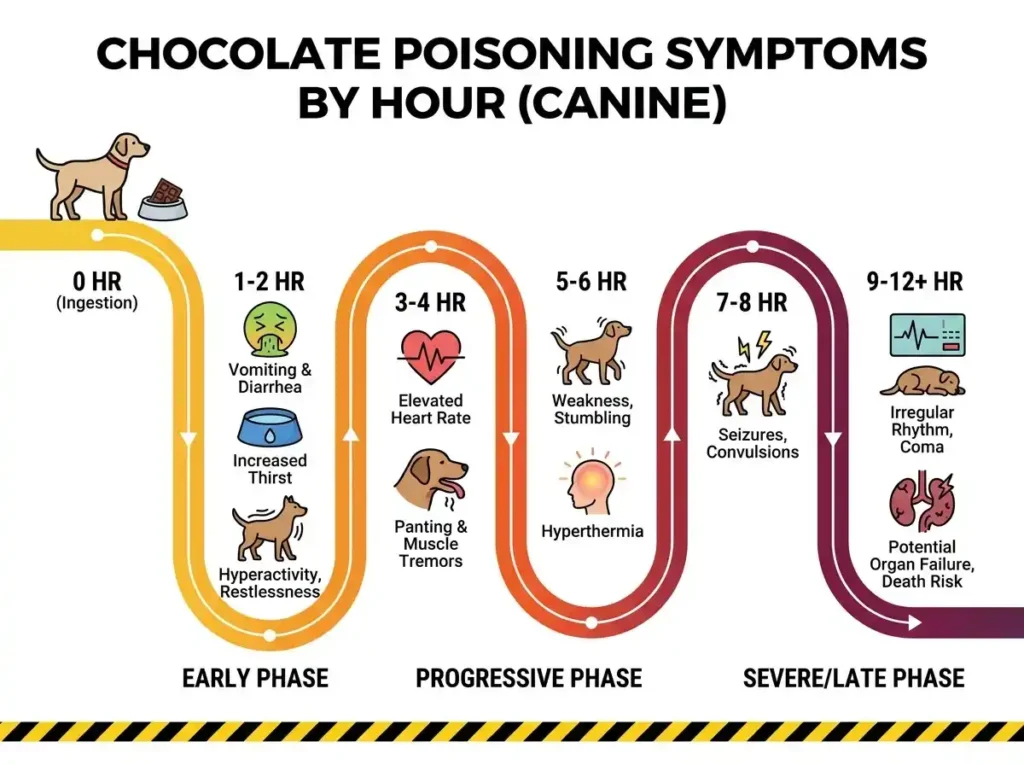
Symptoms Timeline: How Much Chocolate Is Toxic to Dogs Over Time
Symptoms don’t show up instantly. Here’s the general pattern reported by veterinary sources:
- First 2–4 hours: Vomiting, diarrhea, restlessness, increased thirst.
- 4–12 hours: Increased heart rate, hyperactivity, muscle tremors.
- Beyond 12 hours (in more severe cases): Elevated body temperature, irregular heart rhythm, seizures.
Symptoms can persist for 24–72 hours because theobromine is metabolized slowly in dogs, which is part of why they’re so much more sensitive to chocolate than humans are.
Not every dog that eats chocolate will show every symptom, and mild cases may just look like an upset stomach. That said, “wait and see if symptoms show up” is not a safe strategy for a dark chocolate or baking chocolate ingestion — by the time serious symptoms appear, the situation is already more urgent.
What to Do If You’re Not Sure How Much Chocolate Is Toxic to Dogs
Direct answer: If your dog ate chocolate, don’t wait for symptoms — note your dog’s weight, the type and amount of chocolate eaten, and the time it happened, then contact your vet or an animal poison control hotline immediately, since they’ll use exactly that information to tell you whether home monitoring is enough or an emergency visit is needed.
Steps to take right away:
- Stay calm and don’t induce vomiting yourself unless a vet specifically tells you to — doing it wrong can cause other problems.
- Identify the chocolate type and estimate the amount eaten as accurately as you can (check the wrapper if there is one).
- Weigh your dog or use their most recent known weight.
- Check your dog’s exact toxicity level using the weight, chocolate type, and amount to get an instant risk read.
- Call your vet or animal poison control, ready to share the weight, chocolate type, amount, and how long ago it happened.
- Watch for symptoms over the next 24–72 hours even if you’re told it’s low risk, and call back if anything changes.
- Follow professional guidance exactly — dosing activated charcoal or inducing vomiting at home without direction can make things worse, not better.
If the calculator or your vet flags the ingestion as moderate-to-severe risk, don’t wait to “see how your dog seems” — get to a vet or emergency animal hospital.
Common Mistakes to Avoid
- Assuming a “small bite” is automatically safe. For a small dog and dark chocolate, a small bite can still be a real dose.
- Guessing the chocolate type from memory instead of checking packaging. “Chocolate” covers a 10x range in danger depending on type.
- Waiting for symptoms before acting. Symptoms often lag behind the actual toxic exposure.
- Inducing vomiting without guidance. This isn’t always the right move and can cause complications if done incorrectly or too late.
- Forgetting to account for other toxic ingredients. Chocolate-covered raisins, macadamia nuts, or xylitol-sweetened chocolate products carry additional risks beyond theobromine alone.
FAQ
How much chocolate can a dog eat before it’s dangerous?
It depends entirely on your dog’s weight and the chocolate type — a few ounces of dark or baking chocolate can be dangerous for a small dog, while a large dog may tolerate a similar amount of milk chocolate with only mild symptoms. Use a weight-and-type calculator rather than a general rule of thumb.
Is a small amount of chocolate okay for dogs?
A small amount of milk or white chocolate is often low-risk for a medium-to-large dog, but “small amount” of dark or baking chocolate can still be enough theobromine to cause symptoms, especially in smaller dogs.
What chocolate is most toxic to dogs?
Unsweetened baking chocolate and dark chocolate are the most toxic per ounce because they contain the highest theobromine concentration. White chocolate is the least toxic, since it contains only trace amounts.
How long after eating chocolate will a dog show symptoms?
Symptoms typically start within 2–4 hours and can continue to develop over 12+ hours, with effects lasting 24–72 hours in more serious cases due to how slowly dogs metabolize theobromine.
How much chocolate is deadly for dogs?
A fatal dose is rare but possible when a small dog eats a large amount of dark or baking chocolate. ManualTreat any large ingestion as an emergency — call your vet immediately.
Final Thoughts
The honest answer to “how much chocolate is toxic to my dogs” is: it depends on the two numbers most people don’t think to combine — your dog’s weight and the chocolate’s theobromine concentration. Once you have those two things, the risk level stops being a guess.
If your dog just got into something chocolate-based, don’t spend time cross-referencing tables under pressure — run the numbers through our free Chocolate Toxicity Calculator and call your vet with the result in hand.
Disclaimer: This article is for general informational purposes only and is not a substitute for professional veterinary advice, diagnosis, or treatment. Theobromine sensitivity varies by individual dog, and the figures and thresholds referenced here are general guidelines, not a diagnosis for your specific pet. If your dog has eaten chocolate, contact your veterinarian or an animal poison control hotline immediately rather than relying solely on this article or any calculator tool.