
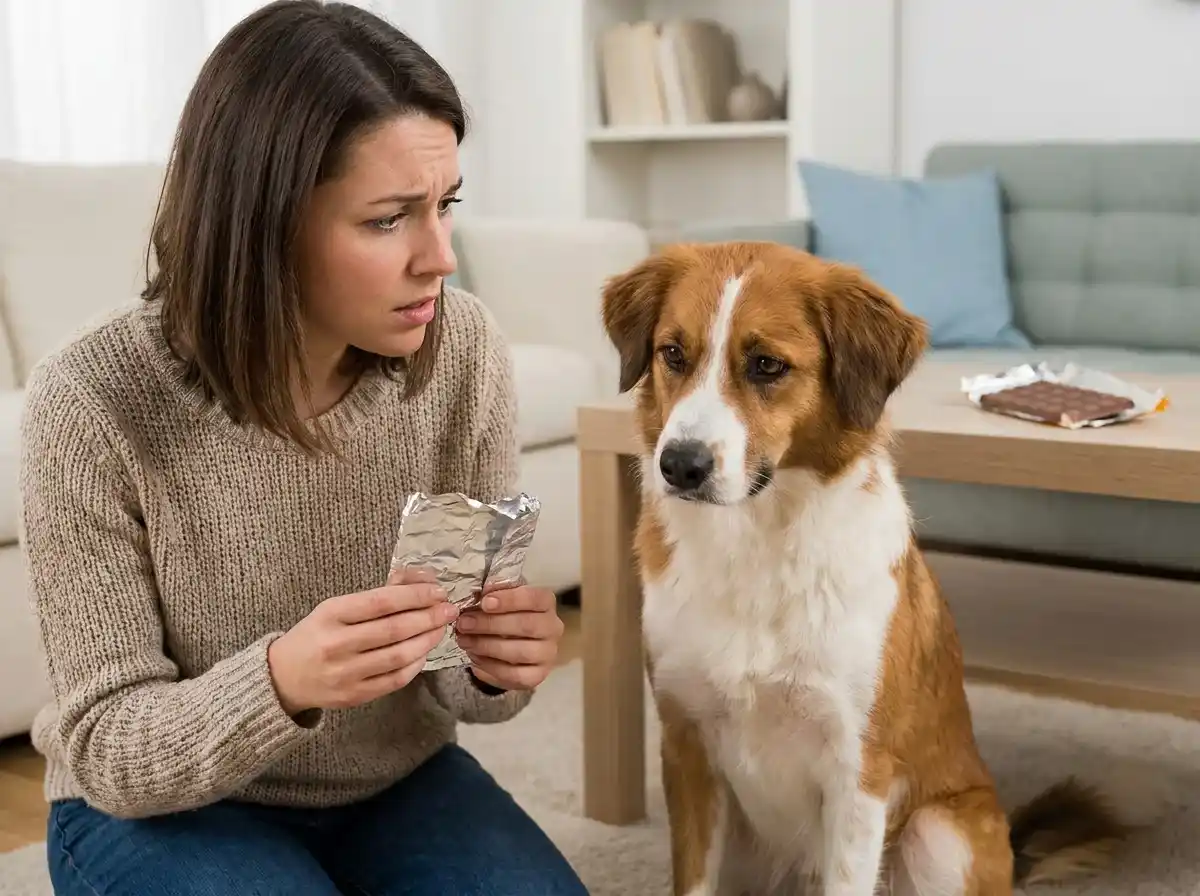
My Dog Ate Chocolate — What to Do Right Now
If your dog ate chocolate, the first thing to do is figure out what kind, how much, and your dog’s weight — then call your vet or an animal poison control line immediately, even if your dog seems fine. Chocolate contains theobromine, a compound dogs can’t break down quickly, and symptoms sometimes don’t show up for hours.
Note: this article is written as general guidance for dog owners searching for what to do in this situation. If you have a real story or outcome from your own dog getting into chocolate, that would make a great addition here — for now, everything below is factual, vet-sourced guidance rather than a personal account.
Why Chocolate Is Dangerous for Dogs (And Why “Wait and See” Is Risky)
Chocolate contains theobromine and a small amount of caffeine — both are stimulants that humans metabolize easily but dogs process very slowly. That slow breakdown is exactly why a small amount of chocolate that would do nothing to a person can genuinely poison a dog.
Darker, less sweet chocolate is more dangerous, ounce for ounce, than milk chocolate. Baking chocolate and cocoa powder are the most concentrated and the most likely to cause serious poisoning even in small quantities. White chocolate has almost no theobromine, so it’s mostly a concern for stomach upset from fat and sugar rather than true poisoning.
How Much Chocolate Is Toxic for Dogs?
Toxicity depends on the type of chocolate, the amount eaten, and your dog’s body weight — a small dog is at far greater risk from the same amount of chocolate than a large dog.
As a general guide from veterinary toxicology references:
- Mild symptoms (vomiting, diarrhea, restlessness) can appear starting around 20 mg of theobromine per kilogram of body weight.
- More serious symptoms (rapid heart rate, tremors) tend to appear around 40–50 mg/kg.
- Seizures become a real risk at 60 mg/kg and above.
To put that in real terms: a 10-pound dog eating just one to two ounces of dark or baking chocolate can already be in the danger zone, while the same dog would need to eat several regular milk chocolate bars to reach a similarly risky dose.
Check Your Dog’s Exact Risk Level
Because the math depends on so many variables — type of chocolate, weight, and how much was actually eaten — a calculator that does this for you is far more reliable than guessing. This is exactly the kind of situation where plugging in the numbers beats trying to eyeball it.
How to Respond If Your Dog Ate Chocolate
If your dog just ate chocolate, follow these steps in order:
- Figure out what and how much. Check wrappers, packaging, or what’s missing from the counter. Note the type of chocolate (milk, dark, baking, cocoa powder) and roughly how many ounces or grams.
- Weigh your dog if you don’t already know their current weight — this matters as much as the amount eaten.
- Call your vet, an emergency animal hospital, or a pet poison control hotline right away. Don’t wait for symptoms. Have the chocolate type, amount, and your dog’s weight ready to tell them.
- Do not induce vomiting on your own unless a vet specifically tells you to and walks you through it — doing it wrong, or at the wrong time, can cause more harm.
- Watch closely for the next several hours, even if you’ve been told it’s a low-risk amount. Symptoms can take a few hours to appear.
- Follow your vet’s exact instructions, whether that’s monitoring at home or bringing your dog in for treatment.
Symptoms That Mean You Need a Vet Immediately
Chocolate poisoning symptoms usually show up within two to four hours of eating it, though it can sometimes take longer. Watch for:
- Vomiting or diarrhea
- Excessive thirst or urination
- Restlessness, panting, or shaking
- A racing or irregular heartbeat
- Muscle tremors
- Seizures
If your dog shows any of the last three — a fast or irregular heartbeat, tremors, or seizures — treat it as an emergency and get to a vet immediately rather than waiting to see if it passes.
What Actually Happens at the Vet
Knowing what to expect can make the situation less stressful. Depending on how recently your dog ate the chocolate and how much, a vet may:
- Induce vomiting if it’s been caught early enough
- Give activated charcoal to bind remaining toxins in the gut
- Put your dog on IV fluids to help flush the theobromine out faster
- Monitor heart rhythm and give medication if arrhythmia or seizures develop
The good news: with prompt treatment, most dogs recover fully. Outcomes get worse mainly when treatment is delayed, when a large amount of dark or baking chocolate was eaten, or once seizures or serious heart rhythm problems have already started.

Common Mistakes Dog Owners Make After Chocolate Exposure
- Assuming “small amount” always means “safe.” Type of chocolate and your dog’s size matter more than the amount alone — a small dog and dark chocolate is a bad combination even in modest quantities.
- Waiting to see if symptoms show up before calling anyone. By the time symptoms appear, you’ve lost hours you could have used to act.
- Trying to induce vomiting without guidance. This can be done incorrectly and cause additional harm, especially in dogs that are already agitated or unwell.
- Not knowing the dog’s current weight. This single number changes the entire risk calculation, so it’s worth keeping an updated weight on hand.
- Throwing away the packaging before checking it. Wrappers often tell you the cocoa percentage or exact ingredients, which helps your vet judge risk accurately.
FAQ: Dog Ate Chocolate
How long after eating chocolate will my dog show symptoms? Symptoms typically appear within two to four hours, though in some cases it can take longer, especially with smaller amounts.
Is milk chocolate as dangerous as dark chocolate for dogs? No. Milk chocolate has much less theobromine than dark, baking chocolate, or cocoa powder, so a dog would need to eat a larger amount of milk chocolate to reach a toxic dose.
Should I make my dog throw up at home? Only if a vet specifically instructs you on how to do it. Done incorrectly or at the wrong time, it can cause more harm than good.
My dog ate chocolate and seems totally fine — do I still need to call the vet? Yes. Symptoms can be delayed by several hours, so a normal-seeming dog right after eating chocolate isn’t a guarantee they’re in the clear.
Final Thoughts
The core of this situation is simple: don’t guess, don’t wait, and don’t assume “it was just a little bit” means it’s automatically fine. Get the details — type, amount, weight — and get a professional opinion fast. A quick call costs you a few minutes; a delayed one can cost your dog’s health.