
7 Vital English Bulldog Cooling Tips to Prevent Summer Overheating Safely
By a real bulldog owner who learned the hard way
Last July, I nearly lost my English Bulldog, Winston, to heatstroke.
It was only 82°F outside — not even a scorcher by most people’s standards. I’d left him in the backyard for about 20 minutes while I brought in groceries. When I came back, he was lying flat on the patio, breathing in these horrible, rattling gasps, his tongue almost purple. I scooped him up, soaked him with cool water, and rushed to the vet in full panic mode.
The vet told me something I didn’t fully appreciate until that moment: English Bulldogs are physiologically incapable of cooling themselves the way most dogs can. Their squished, flat faces — that adorable feature we all love — make panting almost useless. It’s like trying to cool a running engine through a coffee straw.
Winston was okay, thankfully. But that afternoon changed how I handle every single summer day with him. If you have an English Bulldog and warm months are coming, please read every word of this.
Why English Bulldogs Overheat So Fast
Before I get into the tips, you need to understand why your bulldog is in a completely different category from, say, a Labrador or a German Shepherd when it comes to heat.
Bulldogs are brachycephalic — meaning their skull shape gives them that flat-faced look. That also means their airway is narrower, their soft palate is often elongated, and their nostrils can be pinched. When a regular dog overheats, they pant hard and rapidly exhale hot air. Bulldogs can’t move enough air to do that effectively.
Add to that their stocky, low-to-the-ground body that absorbs heat from hot pavement, their tendency to be overweight, and their generally lazy nature (they won’t tell you they’re hot — they’ll just collapse), and you have a dog that can go from fine to critical in 10–15 minutes on a warm day.
Now — here’s how to stop that from happening.
Tip 1: Know the Real “Safe” Temperature Limit (It’s Lower Than You Think)
Most people assume their bulldog is fine until it’s 90°F or above. That’s wrong.
For English Bulldogs, I treat anything above 75°F as potentially dangerous if they’re outside for more than a few minutes — especially in direct sun. When humidity is high, I drop that number even lower. Humid heat is far more dangerous than dry heat because the moisture in the air limits evaporative cooling, which is already minimal in bulldogs.
I use a simple weather app called Weather Underground to check not just temperature but the “feels like” temperature and humidity. If feels-like is above 80°F, Winston stays inside on climate-controlled air. No exceptions.
The mistake I made: I was going by air temperature alone and ignoring that pavement and patio surfaces can be 40–60°F hotter than ambient air. On a 78°F day, that concrete could be 120°F. Your bulldog’s belly is inches from it.
Do the seven-second test before every walk: press the back of your hand on the pavement. If you can’t hold it there comfortably for 7 seconds, it’s too hot for your dog’s paws and belly.
Tip 2: Set Up a Cooling Station — Not Just a Water Bowl
A water bowl in the corner is not a cooling station. I had one for two years before I built an actual system, and looking back, I was winging it.
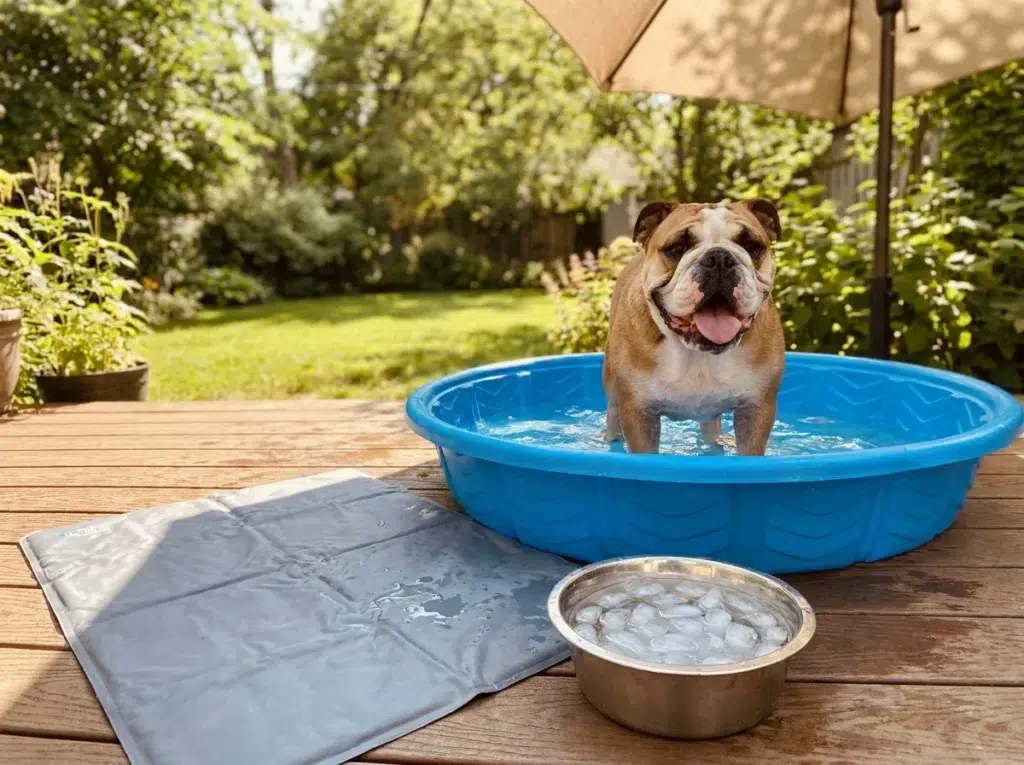
Here’s what Winston’s cooling station now looks like:
- A shallow kiddie pool (I got a hard plastic one from Walmart for about $12). It’s only about 4 inches of cool water. He doesn’t swim — he just stands in it. That contact with cool water on his paws and belly drops his core temperature surprisingly fast.
- A Cooling mat — I use the Green Pet Shop Cooling Mat. These are gel-filled and activate through your dog’s body pressure, no electricity needed. Winston absolutely loves this thing. It stays cool for a couple of hours.
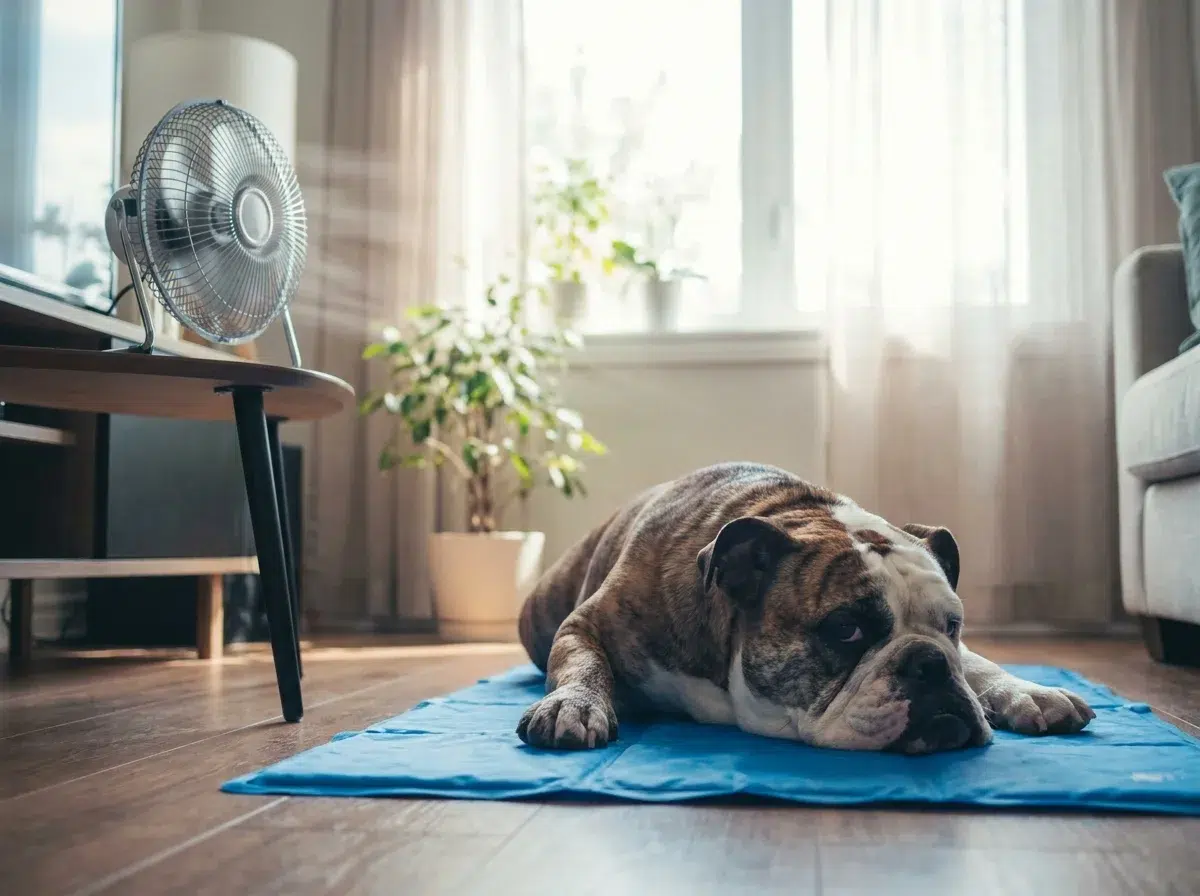
- A fan aimed low — not a ceiling fan, but a box fan or oscillating fan pointed toward the floor where he lies. Moving air over a cool mat makes a significant difference.
- Fresh, cold water with ice — I drop two or three ice cubes in his bowl. Most bulldogs will drink more if the water is cold. Hydration is a massive part of preventing overheating.
This whole setup costs under $60 and it works better than anything else I’ve tried.
Tip 3: Relearn When to Walk Him
When I first got Winston, I walked him at 7:30 AM and 6:30 PM — morning and after work. That worked fine in fall and winter.
In summer, those times are wrong.
For summer walks, the only truly safe window is before 7:00 AM — when the pavement hasn’t had time to absorb heat — and after 8:30 PM, when it’s had a couple of hours to cool down. That gap feels inconvenient. It is. But bulldogs don’t need long walks anyway.
Winston gets a 10-minute walk at 6:30 AM and another short one around 9 PM on warm evenings. The rest of his exercise is gentle indoor play — tugging a rope toy, sniffing around the house, stuff that doesn’t spike his heart rate or generate serious body heat.
On days above 85°F, we skip outdoor walks entirely. He gets enrichment inside: puzzle feeders, hide-and-seek with kibble, nose work games. His brain gets tired even if his body doesn’t, and he’s perfectly content.
The lesson I learned the hard way: Bulldogs don’t pant loudly to tell you they’re too hot the way other breeds do. They just slow down. And then they stop. By the time you see obvious distress, you’re already behind the curve.
Tip 4: Keep the Indoor Temperature Below 78°F
This sounds obvious but it isn’t. A lot of people cool the house to a comfortable human temperature — maybe 76–80°F — and assume the dog is fine.
But bulldogs sit on the floor, where air doesn’t circulate as well. They wear a thick coat they can’t take off. And their resting body temperature generates more heat than you realize.
I keep our main living areas at 74°F or below during summer. Yes, that costs more on the electric bill. Yes, it’s worth it. I also have a second window AC unit in the room where Winston spends most of his afternoon, just as a backup.
If you don’t have central AC or want a cost-effective solution, a portable evaporative cooler (swamp cooler) works decently in low-humidity climates. In humid areas, they’re less effective — stick to a real AC unit.
One thing I added last summer was a smart plug on a mini-split unit connected through the Google Home app. If I’m out and I check the home temperature remotely and it’s crept up, I can turn on additional cooling from my phone. Small thing, huge peace of mind.
Tip 5: Learn the Signs of Overheating Before You Need Them
I’m going to be direct here: if you wait until your bulldog looks “really bad,” you’re probably already dealing with an emergency.
Early warning signs that I watch for now:
- Excessive drooling, more than his normal level (and bulldogs drool a lot, so you need to know YOUR dog’s baseline)
- Louder or more labored breathing than usual
- Bright red gums or tongue
- Acting “drunk” — wobbly, disoriented
- Seeking out the coolest spot in the house obsessively (he does this anyway, but urgently is different)
- Refusing to get up even for treats (Winston never refuses treats — this would be a red flag immediately)
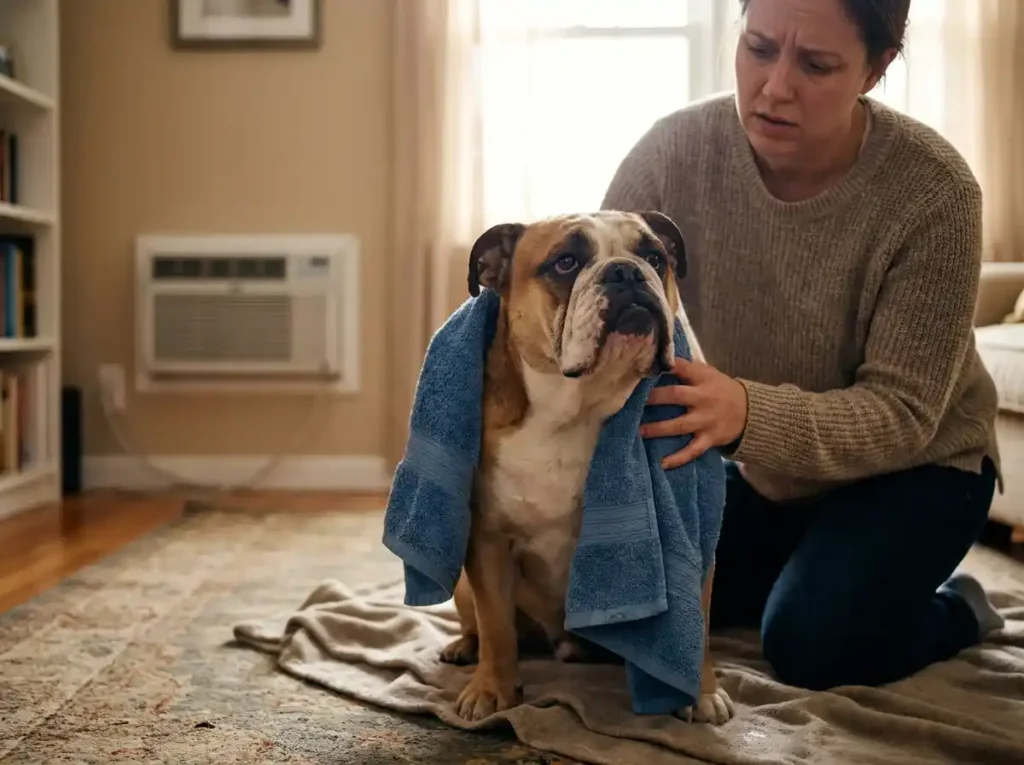
If you see more than one of these: get cool (not ice cold) water on the neck, armpits, and groin. Offer water to drink if he’s alert. Get him into AC. Call your vet on the way there — don’t wait to see if he improves.
Do NOT use ice-cold water or ice baths. This causes the blood vessels near the skin to constrict, which actually traps heat inside the body. Cool water — think comfortable pool temperature — is what you want.
Tip 6: Watch His Weight Like It’s Your Job
Every extra pound on an English Bulldog is a compounding heat risk. Excess weight means more effort to breathe, more heat generated at rest, and a cardiovascular system working harder in the heat.
Winston hit 58 lbs at one point — his vet said ideal weight for his frame was around 50–52 lbs. Those 6–8 pounds made a measurable difference in how hot he got, how quickly he fatigued, and how loudly he breathed in warm weather.
I switched him to a lower-calorie kibble (Royal Canin Bulldog formula, which is also shaped specifically for their jaw), reduced his treats, and added short indoor activity sessions. He’s now a stable 51 lbs and the difference is real.
I’m not saying weight is the whole story. But if your bulldog is overweight and struggling in summer, this is the lever that gives you the most return.
Tip 7: Have a Heat Emergency Kit Ready
I keep a small bag by the door that I think of as Winston’s “oh no” kit. It has:
- A microfiber cooling towel (the kind athletes use — get it wet and it stays cool for a long time)
- A collapsible water bowl and a small frozen water bottle I rotate out of the freezer on hot days
- My vet’s number AND the nearest emergency animal clinic’s number saved in my phone
- A printout of heatstroke first aid steps for dogs (because when you’re panicking, you forget things)
The frozen water bottle does double duty: it keeps the bag cool, and when it thaws a bit, it becomes drinking water for Winston. On walks, I can pour it over his head and neck if I need to cool him fast.
It sounds like overkill. It isn’t. When Winston was in distress that July afternoon, I was scrambling for anything cold. Now I’m not.
Common Mistakes Bulldog Owners Make in Summer
I’ve made most of these. You might be making some too:
Assuming shade is safe. Shade reduces sunburn risk but doesn’t eliminate ambient heat. A shaded backyard on a 90°F day is still 90°F.
Leaving them in a car “just for a minute.” The interior of a parked car on an 80°F day can hit 110°F in under 10 minutes. This is never okay, ever.
Thinking a young, healthy bulldog is safe. Heatstroke hits young bulldogs too. Age and health status don’t make them immune.
Over-exercising them in “mild” weather. A brisk 30-minute walk at 75°F can push a bulldog into dangerous territory, especially if they’re not in great shape. Short and slow is always the rule.
Ignoring post-swim exhaustion. Some bulldogs love water play. Great — but the exertion involved can raise body temperature fast. Always have cool-down time after water play, indoors with AC.
The Bottom Line
Living with an English Bulldog in summer isn’t scary if you’re prepared. These dogs are magnificent, funny, deeply loving companions — but they rely entirely on us to manage their environment because they genuinely cannot do it themselves.
Winston is snoring next to me right now, completely unbothered by the world. That’s the goal: a safe, comfortable bulldog who has no idea how close the margins really are.
Build the cooling station. Know the signs. Stick to early morning and late evening outdoor time. Keep the house cool. And please, don’t underestimate how fast things can go wrong.
Your bulldog is counting on you to know what they can’t tell you.
FAQS
Q1: What temperature is too hot for an English Bulldog?
A: Any temperature above 75°F can be dangerous for English Bulldogs, especially in direct sunlight or high humidity. Unlike other breeds, bulldogs can’t pant effectively due to their flat faces, so they overheat much faster than you’d expect.
Q2: How do I cool down an English Bulldog quickly?
A: Apply cool (not ice cold) water to their neck, armpits, and groin area. Move them into an air-conditioned space immediately, offer fresh cold water to drink, and place them on a cooling mat. If symptoms don’t improve within minutes, call your vet right away.
Q3: Can English Bulldogs be outside in summer?
A: Yes, but only during the coolest parts of the day — before 7:00 AM and after 8:30 PM. Always check that pavement isn’t too hot using the 7-second hand test, keep outdoor time short, and never leave them unsupervised in the heat.