
French Bulldog Training – The Complete Guide for New Owners
French Bulldog training is one of the most searched topics in the breed world — and also one of the most misunderstood by new owners. The reputation is that they’re stubborn, difficult, and basically untrainable unless you have endless patience and a pocket full of treats. That reputation is half true and half exaggerated.
French Bulldog training absolutely requires patience. It also requires understanding why they behave the way they do — because once you understand that, the whole process becomes significantly less frustrating. This guide covers everything a new Frenchie owner needs: basic obedience, potty training, socialization, common behavior problems, and the methods that actually work with this specific breed.
Understanding French Bulldog Behavior Before You Start Training
Before any command, any leash, any treat — you need to understand what you’re working with. French Bulldogs are not a working breed. They were developed as companion dogs, bred specifically to be near people and to respond to human social cues. That’s actually an advantage in training, because Frenchies genuinely want to interact with you.
The stubborn streak is real, but it’s often misread. What looks like stubbornness is usually one of three things: the dog doesn’t understand what’s being asked, the reward isn’t motivating enough, or the dog is physically uncomfortable — overheated, tired, or struggling to breathe after activity. Brachycephalic dogs have a lower exercise threshold than most breeds, and pushing training sessions when a Frenchie is physically taxed produces poor results.
What Motivates a French Bulldog in Training
Food is the primary motivator for most Frenchies, and high-value treats — small pieces of cooked chicken, cheese, or purpose-made soft training treats — work dramatically better than dry kibble when you’re introducing a new behavior.
Praise matters too, but it works best paired with food, especially in the early stages. Once a behavior is reliably established, you can fade the food reward and rely more on praise and affection — but trying to skip food rewards entirely at the start is one of the most common reasons French Bulldog training stalls.
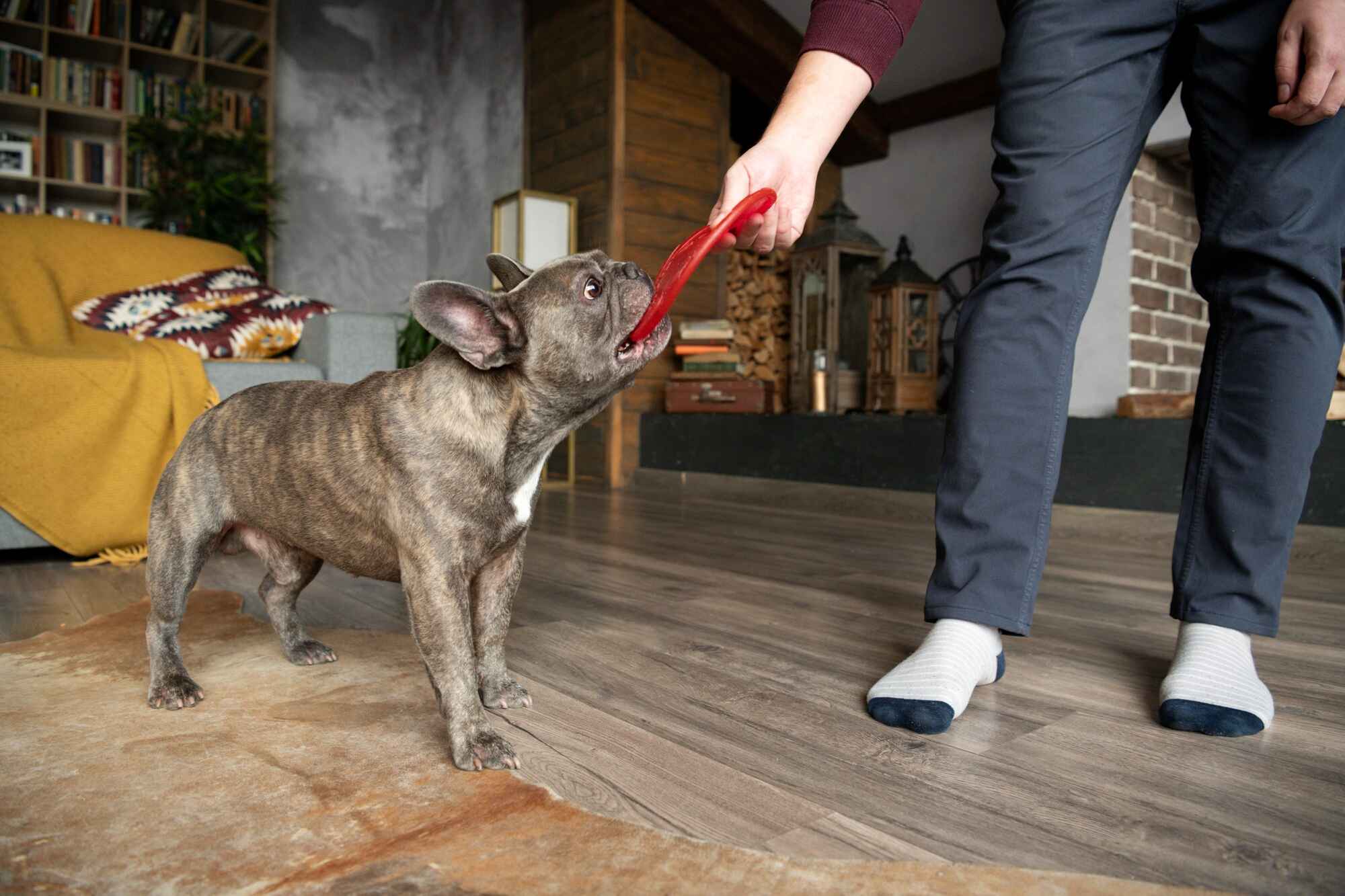
Play can also be a reward, but keep it brief. A 30-second tug game as a reward works well for some Frenchies; others are too food-focused to care about toys when treats are on the table.
French Bulldog Obedience Training: The Core Commands to Start With
New owners often make the mistake of trying to teach everything at once. Start with the five commands that have the most practical value and build from there.
Sit — The Foundation Command
Sit is almost always the right starting point. It’s simple, it creates a default “waiting” behavior that transfers to dozens of real-world situations (before meals, before going through a door, before meeting a new person), and most Frenchies pick it up quickly.
How to teach it: Hold a treat close to your Frenchie’s nose, then slowly move your hand up. Their bottom will naturally lower as their nose follows the treat upward. The moment their rear touches the floor, say “sit,” mark it with a “yes” or a click if you’re using a clicker, and give the treat. Practice in 3–5 minute sessions, 2–3 times per day.
Stay, Come, Down, and Leave It
Once Sit is reliable, add these in roughly this order:
- Down — builds on Sit, teaches impulse control
- Stay — extends the value of both Sit and Down in real-world situations
- Come — the most important safety command; always reward heavily, never punish a dog for coming to you even if they took a long time
- Leave it — practical for preventing your Frenchie from eating something dangerous off the ground, which they absolutely will attempt
Loose Leash Walking
Frenchies aren’t pullers in the same way that high-drive breeds are, but many develop a habit of plowing forward on the leash because their owners follow wherever they go. Teaching loose leash walking early prevents a frustrating habit from forming.
The method that works best: stop completely every time the leash goes tight. The moment the dog backs up and slack returns, continue walking. It feels slow at first but produces reliable results within a few weeks of consistent practice.
How to Potty Train a French Bulldog Puppy
French Bulldog potty training gets a reputation for being slow. It doesn’t have to be, but it does require consistency that most first-time owners underestimate at the start.
Here’s the process that works:
- Establish a fixed schedule immediately. Puppies need to go out first thing in the morning, after every meal, after every nap, after play sessions, and before bed. For puppies under 12 weeks, that can mean 8–10 trips outside per day.
- Use a consistent outdoor spot. Taking the puppy to the same area each time helps them associate the location with the behavior. The familiar scent reinforces what they’re there to do.
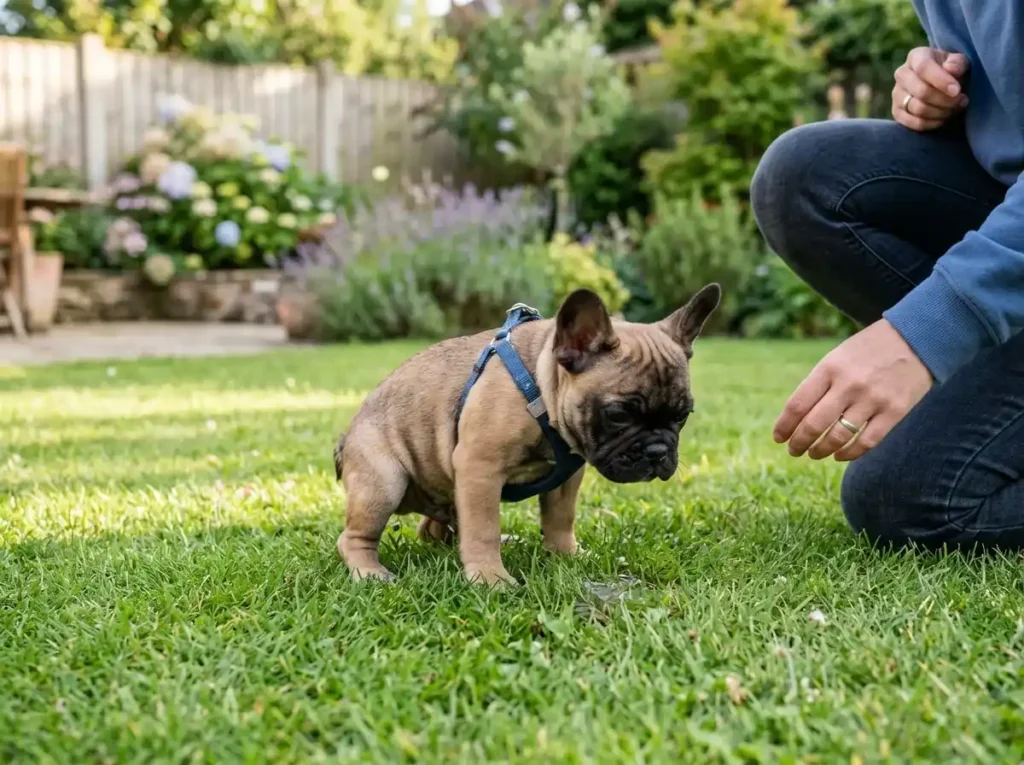
- Go out with them — don’t just send them. You need to be present to mark the moment it happens. Say a cue word (“go potty,” “outside,” whatever you’ll use consistently) right as they begin, then reward immediately when they finish — not when you’re back inside.
- Supervise indoors completely. When a young puppy is inside, they should be either directly watched or confined to a crate or pen. Unsupervised puppies make unsupervised mistakes, and every indoor accident makes the pattern slightly harder to break.
- Never punish after the fact. If you find a puddle and the puppy isn’t standing over it right now, punishment is pointless and harmful. Dogs don’t make the connection between a past event and a current correction. Clean it up with an enzymatic cleaner and improve your supervision.
- Expect the process to take 4–6 months for reliability. Most Frenchies aren’t fully reliable until around 6 months. Some take longer. Night dryness often comes after daytime reliability is established.
French Bulldog Behavior Problems and How to Address Them
Excessive Barking in French Bulldogs
Frenchies aren’t big barkers by nature, but some develop a habit of barking for attention — particularly if barking has worked in the past (i.e., you came over, gave attention, or gave a treat to quiet them). The fix is the same in most cases: ignore the barking completely and reward quiet behavior. This feels wrong at first, but reacting to barking — even to tell them to stop — is still attention, and attention is what they wanted.
Resource Guarding
Some French Bulldogs develop guarding behavior around food, toys, or resting spots. This ranges from mild stiffening to growling to snapping. It’s important to address early and, if it escalates beyond mild growling, to consult a professional — resource guarding that goes unaddressed tends to get worse, not better.
For mild cases, the approach is counter-conditioning: teach the dog that a person approaching their bowl or toy predicts something even better. Drop high-value treats near the bowl while they’re eating. Trade objects rather than taking them directly. Over time, your presence near valued items becomes associated with good things rather than a threat.
Not sure if your Frenchie is at a healthy weight? Use our weight calculator to check.
Separation Anxiety in Frenchies
French Bulldogs are companion dogs to the core, which means they’re prone to distress when left alone. Signs range from whining and pacing to destructive behavior and house soiling specifically when alone.
Prevention is far easier than treatment. From the first week, practice brief departures — even just stepping outside for 30 seconds and coming back calmly. Gradually extend the time. Avoid making departures and arrivals emotionally charged events. A Kong stuffed with frozen food can help bridge the gap by giving the dog something to focus on when you leave.
For established separation anxiety, a certified behaviorist is worth consulting — this is one area where DIY approaches frequently make things worse before they get better.
Socializing Your French Bulldog: Why It Matters and When to Start
Socialization is not the same as training, but it’s inseparable from producing a well-behaved adult dog. A French Bulldog that wasn’t properly socialized during the critical window — roughly 3 to 16 weeks — is significantly harder to train because fear and anxiety interfere with learning.
What Good Frenchie Socialization Looks Like
The goal isn’t exposure for its own sake — it’s positive exposure. Flooding a puppy with overwhelming experiences doesn’t build confidence; it builds fear.
Good socialization means:
- Meeting a wide variety of people (different ages, sizes, appearances, uniforms)
- Encountering different surfaces (grass, gravel, tile, metal grates, stairs)
- Hearing different sounds at manageable volumes (traffic, children, other dogs)
- Short, positive interactions with vaccinated, friendly dogs
- Novel objects and environments introduced at the puppy’s pace
Each new experience should end on a good note. If the puppy is clearly overwhelmed, reduce the intensity and come back to it more gradually.
Socialization After the Puppy Window
If you’ve adopted an older French Bulldog that missed early socialization, the process is slower but not impossible. The same principles apply — gradual exposure, positive association, no forced interactions — but progress takes longer and you may need to manage rather than fully overcome certain fears.
Common French Bulldog Training Mistakes New Owners Make
Training sessions that run too long. Five minutes of focused training twice a day produces better results than a 30-minute session. Frenchies lose interest and start offering random behaviors or shutting down entirely when sessions drag. Short, frequent, and upbeat is the formula.
Inconsistency across household members. If one person allows the dog on the furniture and another doesn’t, the dog learns that rules are negotiable. Rules need to be consistent across everyone in the home, or you’ll spend months undoing confusion.
Punishing a behavior you accidentally reinforced. If your Frenchie jumps up and you’ve been pushing them down while talking to them and making eye contact, you’ve been rewarding jumping with attention. Punishing it now while the reinforcement history is still strong is confusing for the dog. The fix is to turn away completely and reward four-paws-on-the-floor instead.
Using the crate as punishment. The crate is a management and safety tool, and a place the dog should feel secure. Sending a dog to the crate as a punishment for bad behavior undermines both — the dog begins to fear the crate, and you lose one of your most useful management tools.
Giving up too early on potty training. The most common time owners declare their Frenchie “impossible to potty train” is around 10–14 weeks, which is ironically right before puppies start to get genuinely reliable. Consistency at that frustrating stage is what separates early success from a months-long struggle.
Skipping recall practice because the dog “always comes anyway.” A Frenchie that comes reliably now, in low-distraction environments, is not necessarily a dog that will come when it really matters. Recall needs to be practiced regularly, heavily rewarded, and never poisoned by using it to end fun things.
FAQ: French Bulldog Training
Are French Bulldogs hard to train?
French Bulldogs are moderately easy to train with the right approach, and genuinely challenging with the wrong one. They respond well to positive reinforcement and food motivation but shut down quickly with harsh corrections or long repetitive sessions. The breed’s reputation for being stubborn is mostly a result of training methods that don’t suit them — not an inherent unwillingness to learn.
What age should I start training my French Bulldog?
Start the day they come home, which is typically around 8 weeks. Young puppies absorb information quickly, and basic behaviors like Sit and name recognition can be introduced almost immediately. Potty training and crate training should begin on day one. Formal obedience classes are typically appropriate from 12–16 weeks once basic vaccinations are complete.
How long does it take to potty train a French Bulldog?
Most French Bulldogs reach consistent daytime reliability between 4 and 6 months with a proper schedule and supervision. Night dryness often follows. Some individuals take longer — 8 to 9 months isn’t unusual. The biggest factor is the consistency of the owner’s schedule, not the dog’s intelligence.
Can I train an adult French Bulldog?
Yes. Adult French Bulldogs can absolutely learn new behaviors and break old habits. The process may take longer than with a puppy, particularly for deeply ingrained behaviors, but adult dogs are often easier to train in some respects because they have better focus and aren’t in the same state of constant distraction as puppies.
The Honest Reality of Training a French Bulldog
French Bulldog training isn’t a straight line. There will be weeks where everything clicks and weeks where you wonder if they’ve forgotten their own name. That’s normal, and it’s normal for this breed specifically.
What separates owners whose Frenchies turn into genuinely well-behaved companions from those who spend years managing chaos is consistency more than technique. The right method applied inconsistently produces inconsistent results. A simple, clear approach applied consistently — every day, by everyone in the household — produces a dog that’s a genuine pleasure to live with.
Start simple, stay patient, keep sessions short, and reward heavily. The French Bulldog stubbornness that everyone warns you about tends to evaporate pretty quickly once the dog figures out that training is where the good stuff happens.